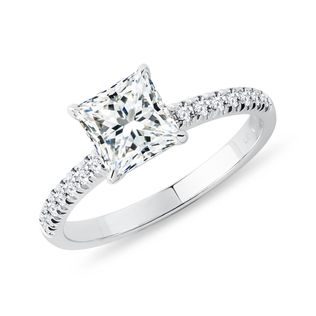
When choosing a piece of jewelry, design, craftsmanship and emotion all play a part. But with precious metals and diamonds, it is just as important to know exactly what you are buying – and to have it in writing. That is what a certificate of authenticity is for: a document that clearly sets out the properties of the piece, the materials used and any set gemstones. For diamonds, it describes the stone's quality in detail and lets you verify that the diamond in your ring really is the one the seller claims it to be.
In this article we explain what a jewelry certificate of authenticity contains, how to read a diamond certificate using the 4Cs, and how to check a stone's authenticity yourself.
What a certificate of authenticity is for – and why to insist on one for diamonds
A certificate of authenticity is the most reliable way to confirm what you are actually buying. For diamond jewellery, it proves the stone has undergone expert grading and guarantees its specific properties – from weight to cut quality.
The certificate matters most when buying online, where you cannot inspect the piece in advance or have it assessed by a jeweler. In that case it is your assurance that you are not buying a stone of lower quality than stated. That is why you should always request one when buying diamond jewelry.
Together with the invoice, the document also serves as proof of purchase and as a warranty card – you will need it, for example, for any future repair or adjustment.
What a jewelry certificate of authenticity contains
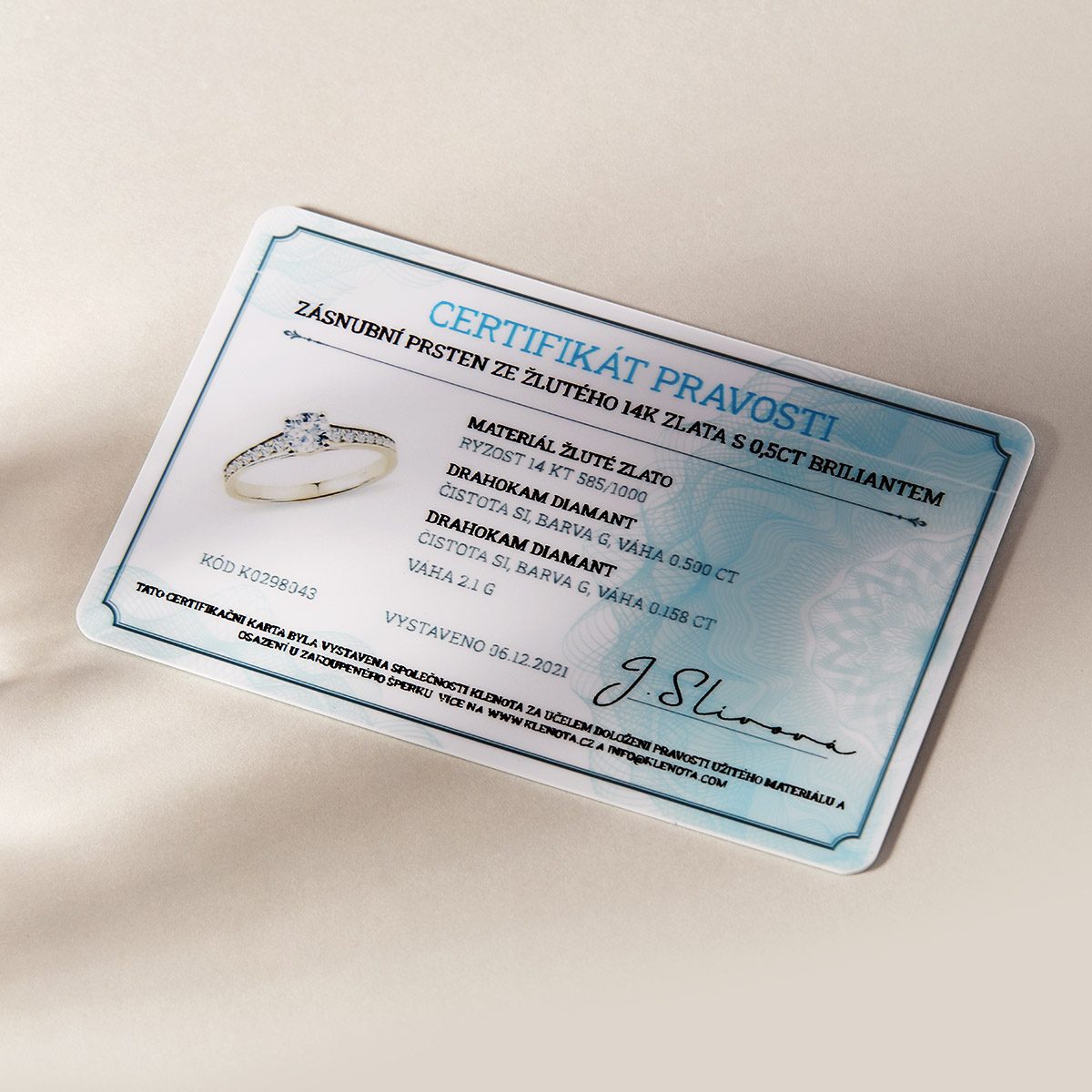
A certificate of authenticity works as an overview of the key properties of a specific piece. It typically states:
- the type of jewelry,
- the type of metal used and its fineness,
- details of any set gemstones,
- for diamonds, their clarity, color and weight in carats,
- the date the certificate was issued,
- the total weight of the piece.
The total weight may differ slightly from the figure in the product description online. This is due to the nature of handcrafted work – every piece is, to some extent, unique.
Every KLENOTA piece comes with its own certificate of authenticity. For details of exactly what it contains, see Certificates of Authenticity at KLENOTA.
When a piece also comes with an international diamond certificate
For larger diamonds, the seller's in-house certificate is not enough – confirmation of quality is taken over by an independent gemological laboratory. Jewelry with clear natural diamonds in a brilliant cut weighing over 0.30 ct therefore usually comes with a certificate from one of the international gemological laboratories. Most lab-grown diamonds carry an international certificate as well.
This is not just another sheet of paper. The certificate confirms the diamond's specific properties based on expert analysis carried out by specialists using modern technology. It provides precise, independent information about the stone's quality and its potential to hold value over time.
What a diamond certificate tells you: the 4Cs
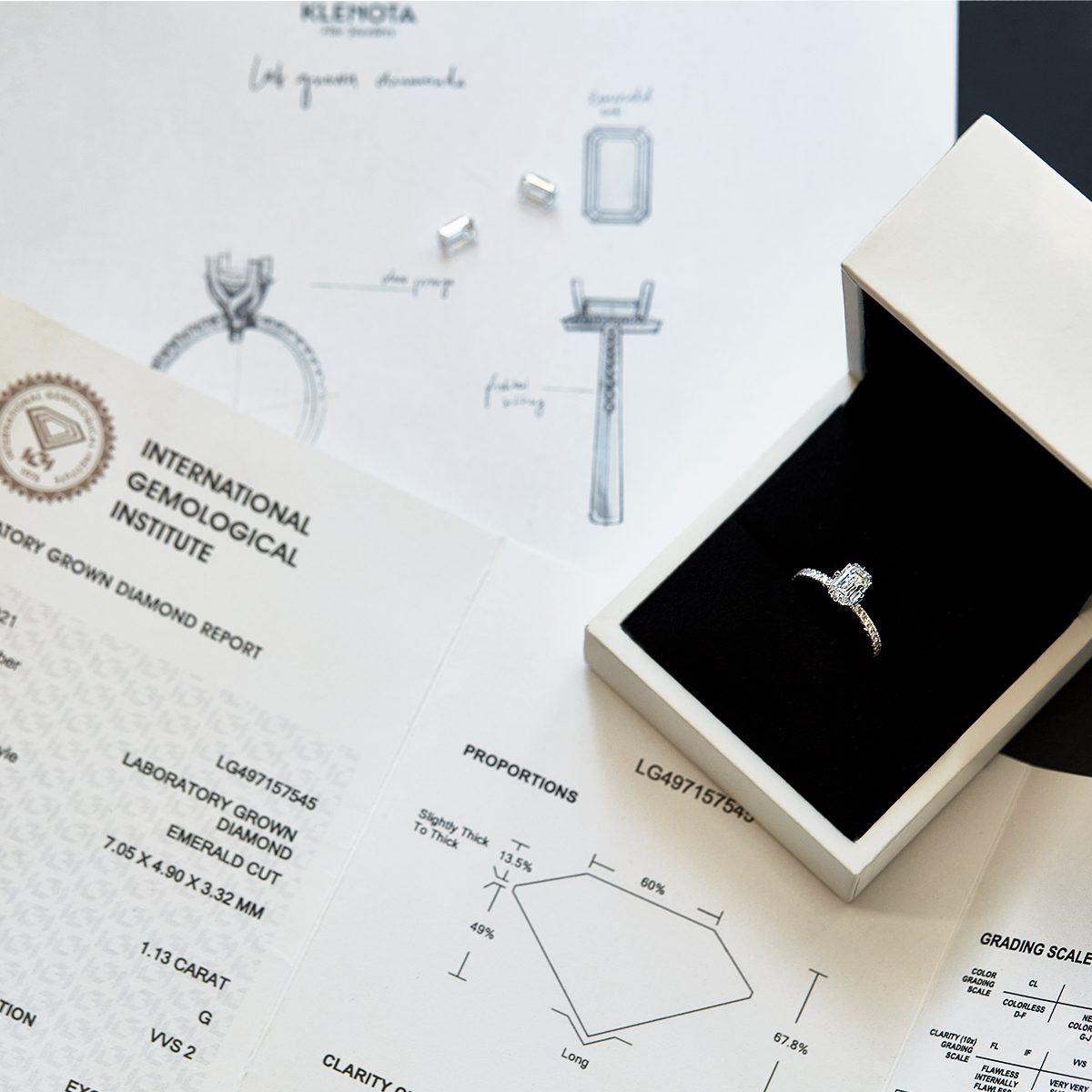
Every certified diamond undergoes thorough analysis in a gemological laboratory. The scope of the document varies by type – a good example is the Diamond Origin Report by the American institute GIA, intended for grading clear diamonds.
The certificate always states the date of issue and the stone's unique identification number, its precise dimensions and the shape of the cut. The core of the grading, however, is the four properties known as the 4Cs: carat, color, clarity and cut.
Carat – the diamond's weight
A diamond's weight is given in carats, with one carat equal to 200 milligrams. Carat weight affects a stone's size and value, but on its own it says nothing about overall quality: two diamonds of the same weight can look quite different depending on shape, proportions, clarity, color and cut. Learn more in the article „What is a carat and how it affects a diamond's value“
Color – the diamond's color
For clear diamonds, it is not the intensity of color that is graded but rather the absence of any unwanted tint. A scale lettered from D (completely colorless) to Z is used. The higher up the scale, the rarer and more colorless the stone. See the article „ Classifying clear natural diamonds by color“, for details.
Clarity – the diamond's clarity
Clarity expresses the degree of internal inclusions and external blemishes in the stone. Their number, size, position and character are assessed, as well as their overall effect on the diamond's appearance. Grades run from flawless stones (FL, IF) through very small inclusions (VS) to more visible ones (SI and below).
Cut – the quality of the cut
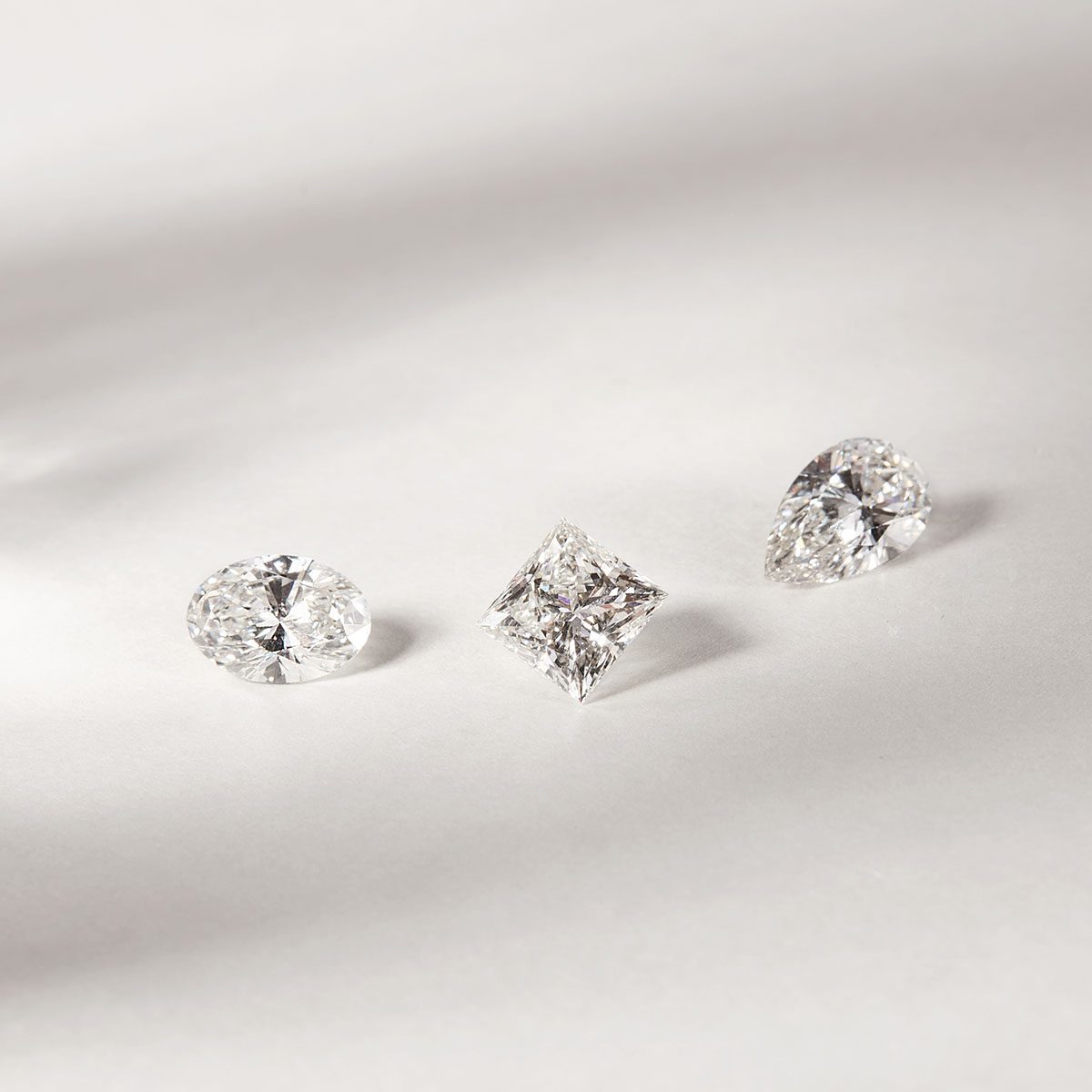
The cut fundamentally affects how a diamond works with light and how intensely it sparkles. On the certificate it is graded on one of five levels, from the highest, Excellent, to the lowest, Poor. The assessment considers the type of cut, the size of the stone relative to its weight, the symmetry of the individual facets and the quality of their polish. The difference between shape and cut is explained in the article „Gemstone shapes – shape and cut are not the same thing“.
 |
 |
Other details on the certificate: polish, symmetry, fluorescence and diagrams
Beyond the 4Cs, the certificate also includes additional grading of polish, symmetry and fluorescence, plus two diagrams that together form a unique "fingerprint" of the specific stone:
- The proportions diagram – an enlarged two-dimensional model of the diamond showing the angles of the individual facets.
- The clarity (inclusions) diagram – records the type, size and exact position of inclusions inside the stone.
Thanks to the second diagram, the certificate is not just proof of quality but also a detailed identification record – no two natural diamonds have their inclusions arranged in the same way.
How to verify a diamond's authenticity using the certificate
The certificate alone is of little use unless you confirm it really belongs to the stone in your piece. Several tools help with this:
- The laser inscription on the girdle. On certified diamonds, the stone's identification number is usually laser-inscribed directly onto the girdle – the outer edge of the diamond. This number must match the number on the certificate. You can check it with a jeweler's loupe or a microscope.
- Online verification in the laboratory's database. A certificate from a reputable laboratory includes a QR code or number that lets you verify the details of a specific diamond directly in its database – for example via GIA Report Check.
- Security features of the document. Paper certificates contain security features (holograms, elements that react to UV light) that confirm their authenticity.
It is worth knowing that certificates are evolving. Some laboratories now issue only digital certificates for smaller stones, accessible via a website or app, or seal the diamond in a protective case with its parameters stated on it.
Which laboratories certify diamonds
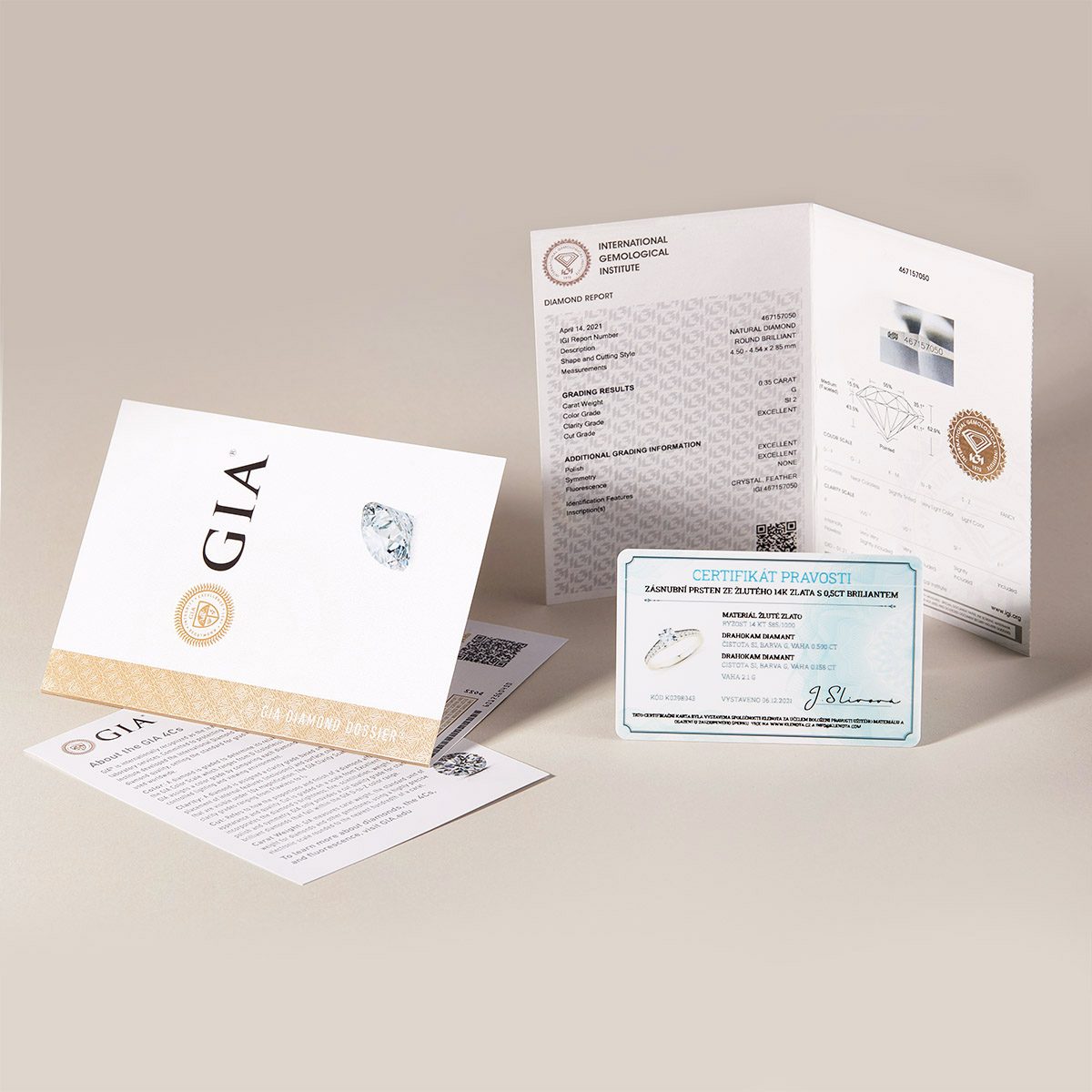
The most important gemological laboratories include:
- GIA (Gemological Institute of America) – the world's leading authority and creator of the 4C system.
- IGI (International Gemological Institute) – an expert in gemstones and finished jewellery.
- HRD (Hoge Raad voor Diamant) – the renowned Antwerp certification laboratory.
For more about each laboratory and examples of their certificates, see Certificates of Authenticity at KLENOTA.
Why it pays to keep your certificate
A certificate of authenticity is not just a formality attached to your purchase. It clearly records the material, gemstones and other properties of your jewelry; together with the invoice it serves as a warranty card; and it can be important for any future adjustments or repairs. With certified diamonds you also gain an independent expert assessment of the specific stone – from its weight and color through clarity to cut quality. So you can be sure you know exactly which piece, and which diamond, you have chosen.
Frequently asked questions
What is a jewelry certificate of authenticity?
It is a document summarising the key properties of a specific piece – the type, the metal and its fineness, any set gemstones and, for diamonds, their color, clarity and weight. It also serves as proof of purchase and a warranty card.
Does every diamond need a certificate?
An in-house certificate of authenticity from the seller should come with every quality diamond piece. An independent international certificate from a gemological laboratory is issued as standard for clear natural diamonds over 0.30 ct and for most lab-grown diamonds.
How can I tell a diamond is genuine from the certificate?
Check that the identification number laser-inscribed on the stone's girdle matches the number on the certificate, and verify the details in the laboratory's online database (for example GIA Report Check). A jeweler's loupe and checking the document's security features also help.
What if a piece has no certificate?
A piece without a certificate can be assessed by an expert at a reputable jeweler, who will confirm the stone's authenticity and quality. When buying – especially online – it is best to request the certificate in advance.